You’ve applied to dozens of jobs. You’re qualified. Your experience matches the requirements. But you never hear back. Your resume is getting rejected—and the frustrating part is, it might not even be reaching a human recruiter.
Every second, recruiters reject resumes without reading them. Not because you’re not qualified, but because your resume fails to pass the first filter: an Applicant Tracking System (ATS). Understanding why your resume gets rejected is the crucial first step toward fixing the problem and finally landing interviews.
If you’re wondering why resume rejection is happening despite your qualifications, this guide reveals the exact reasons—and how to fix each one.
The ATS Gauntlet: Why 75% of Resumes Never Reach a Human
The biggest reason why resume gets rejected has nothing to do with your qualifications. Your resume might never reach a human hiring manager because it fails to pass an Applicant Tracking System (ATS).
Over 75% of large companies use ATS software to scan resumes before any human eyes see them. These systems are designed to identify qualified candidates by searching for specific keywords, formatting patterns, and qualifications. If your resume doesn’t match what the ATS is programmed to find, it’s automatically rejected—no matter how perfect you are for the job.
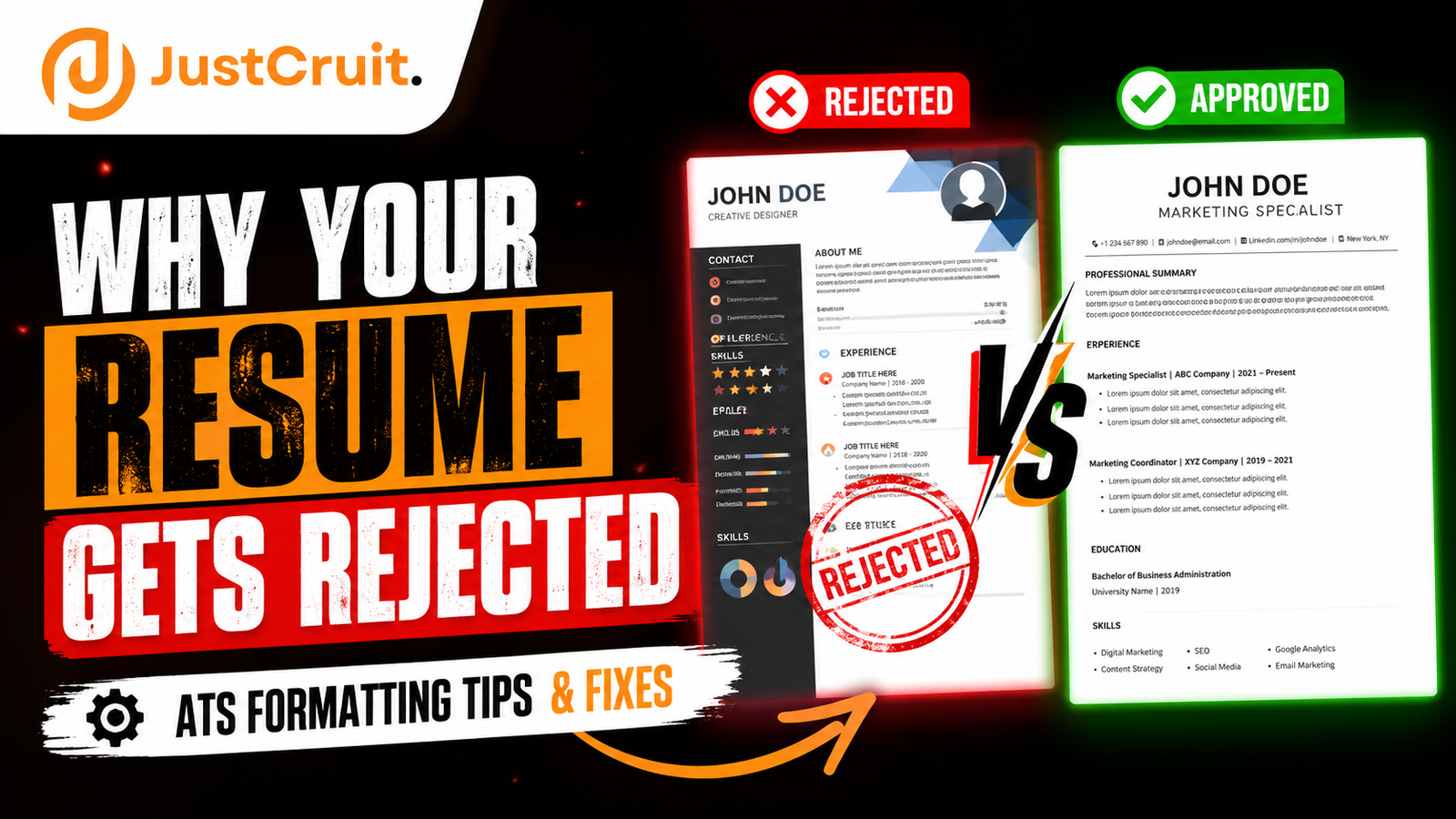
Here’s the problem: ATS systems treat resumes like databases, not like the polished documents you see. They scan for structure, keywords, and formatting. Resumes filled with graphics, tables, columns, or creative formatting completely confuse these systems. The software literally cannot read your resume properly, so it rejects it.
Many job seekers don’t realize this. They spend hours crafting beautiful, visually impressive resumes using templates with fancy fonts, colors, and graphics. Then they’re shocked when they never get callbacks. The resume that looks amazing to a human looks like gibberish to an algorithm.
The fix starts with understanding ATS requirements: save your resume as a clean, simple PDF or Word document; use standard fonts like Arial, Calibri, or Times New Roman (11-12pt); avoid tables, columns, graphics, text boxes, and headers/footers; use simple bullet points with dashes or asterisks; and submit your resume in the format the application specifies.
When you explore job opportunities on JustCruit, the platform guides you on proper resume formatting. More importantly, JustCruit’s recruitment team has deep experience with ATS systems and can help optimize your resume for algorithm success.
Missing Keywords: Why ATS Can’t Find Your Skills
Even if your resume makes it past the formatting gauntlet, it faces another filter: keyword matching. ATS systems search for specific skills and qualifications that the hiring manager identified as essential for the role.
If the job posting says “proficient in JavaScript” and you never use that exact term on your resume (even if you know JavaScript), the system won’t flag you as a match. You could write “experienced with web development programming” which shows you know the skill, but if the specific keyword isn’t there, ATS overlooks you.
This is why resume gets rejected even when you’re qualified. Your experience might be directly relevant, but because you used different terminology than the job posting, the ATS can’t make the connection.
Recruiters now understand this problem better than ever. Professional recruiters at JustCruit specifically look for candidates with aligned keyword matching because they understand how both ATS systems and hiring managers evaluate candidates.
The fix requires strategic keyword alignment:
Read the job description and identify exact keywords and phrases used throughout. Create a “Skills” section near the top of your resume with 15-20 relevant keywords directly from the job posting. Use those same keywords naturally throughout your experience descriptions. Mirror the language the employer uses—if they say “account management,” use that phrase, not “client relationship management.”
If you have experience with a skill but didn’t mention the exact keyword, add it. For example, if you managed social media campaigns but never wrote “social media management,” add that keyword to your skills section and description.
The best practice is to customize your resume for each application. Your base resume remains consistent, but you adjust the skills section and reorder bullet points to emphasize experience most relevant to each specific job. This approach keeps you ATS-optimized while showing recruiters you’ve tailored your application.
Weak Bullet Points: Lacking Quantifiable Impact
Why does your resume get rejected even when it passes ATS screening? Because your accomplishments don’t stand out. Resumes filled with job duties instead of achievements get overlooked by human recruiters reviewing multiple applications daily.
“Responsible for managing social media accounts” tells a hiring manager almost nothing. “Increased Instagram engagement by 340%, growing followers from 8K to 35K in 8 months” shows real, measurable impact that grabs attention immediately.
Weak bullet points are generic and forgettable: “Improved customer satisfaction,” “Enhanced operational efficiency,” “Contributed to team success,” “Assisted with marketing initiatives.” These phrases are so common they blend together. Recruiters can’t distinguish you from other candidates when you use vague language.
Strong bullet points are specific and quantified: “Increased customer satisfaction scores from 72% to 94% through implementation of new quality control procedures,” “Reduced operational costs by $250K annually by optimizing supply chain processes,” “Led team of 5 in developing marketing campaign that generated $1.2M in revenue.”
The pattern is clear: numbers matter. Percentages, dollar amounts, timeframes, and scale make your accomplishments concrete and impressive.
Here’s the fix: Replace every generic responsibility with a specific achievement that includes numbers. Use metrics like percentages, dollar amounts, number of people managed, projects completed, timelines, or improvement rates. Focus on business impact—what did your work result in? Did it save money, generate revenue, improve efficiency, or enhance quality?
Instead of “Managed project development,” write “Led cross-functional team of 8 through $2M product development project, delivered 2 weeks ahead of schedule and 8% under budget.”
When you work with JustCruit’s career coaching services, coaches help you translate your experience into achievement-focused bullet points that grab recruiter attention.
Poor Formatting Kills Readability
Even if your resume has great content and passes ATS screening, poor formatting can still cause rejection. When a resume looks visually chaotic or is difficult to scan, recruiters get frustrated and move on to better-formatted applications.
Recruiters spend an average of 6-7 seconds on each resume. In that time, they need to quickly identify your most relevant qualifications, experience, and skills. If your resume is poorly formatted—dense paragraphs, inconsistent spacing, multiple fonts, cluttered layout—recruiters can’t extract information quickly enough and assume your work is similarly disorganized.
Why resume gets rejected often comes down to presentation. A poorly formatted resume suggests the candidate is disorganized, careless, or doesn’t understand professional standards. In competitive job markets, recruiters use any reason to eliminate candidates and move to the next application.
The formatting fix is straightforward but critical:
Use consistent formatting throughout—same font, same size, same bullet style, consistent date formatting. Employ white space strategically to avoid dense blocks of text. Keep your resume to one page if you have less than 5 years of experience, maximum two pages if you have more. Use clear section headers in logical order: Contact Information, Professional Summary, Experience, Education, Skills, Certifications. Make dates, company names, and job titles easy to locate at a glance. Keep each bullet point to one or two lines maximum.
Think of your resume as a highlight reel you’re scanning in 6 seconds. Every element should be immediately visible and easy to understand. Section headers should jump out. Your most impressive achievements should be immediately obvious.
Consistent formatting also helps ATS systems parse your resume correctly. When formatting is inconsistent, ATS software struggles to identify sections and information correctly, leading to rejection.
Spelling, Grammar, and Typo Catastrophe
One spelling error can trigger immediate rejection. A single typo signals carelessness, poor attention to detail, or lack of professionalism—qualities that concern recruiters across all industries.
Think about it from a recruiter’s perspective: you’re scanning resumes, and one has a typo. That immediately raises a red flag. If the candidate didn’t care enough about the application to proofread, what does that say about their work quality? In competitive industries like law, accounting, writing, editing, and finance—roles where accuracy is critical—a single typo is often disqualifying.
But even in non-detail-oriented roles, typos hurt you. Recruiters are looking for any legitimate reason to narrow down large applicant pools. An error gives them that reason.
The fix is non-negotiable: proofread your resume multiple times; read it aloud to catch errors your eyes skip; ask a trusted colleague or friend to review it; use spell-check tools like Grammarly for additional checking; verify dates, company names, contact information, and all spelled names for accuracy.
Set your resume aside for a day, then review it fresh. You’ll catch errors you missed when you were writing. Have another person review it—they catch things you won’t because you’re too close to the document.
Employment Gaps and How to Address Them
Resumes get rejected when employment gaps go unexplained. Recruiters wonder what happened during that missing time—and their imaginations often go to negative places.
People take time off for completely legitimate reasons: health issues, family responsibilities, caring for a parent, personal development, education, career transitions, or they were simply between jobs. These aren’t disqualifying. But unexplained gaps make recruiters suspicious.
The fix is transparency and context: address significant gaps directly—don’t leave them to speculation; if you had a gap, briefly explain it on your resume or be prepared to discuss it confidently in interviews; use dates strategically to minimize visual gaps if appropriate; include any productive activities during the gap (education, volunteer work, freelance projects, professional development).
For example, instead of having a gap from 2022-2023, you could note: “Professional Development & Career Transition, 2022-2023: Completed Advanced Digital Marketing Certification (Google, HubSpot) and managed 6 freelance client projects in digital strategy.”
This shows you weren’t idle—you were developing skills. It’s honest, it’s productive, and it addresses the gap head-on.
Recruiters at JustCruit understand employment gaps and don’t automatically reject candidates for them. They evaluate the whole candidate, not just the timeline. When working with professional recruiters, they can help you frame gaps positively and prepare to discuss them confidently.
Generic, Weak Professional Summary
Your professional summary is your first chance to grab attention. A weak, generic summary wastes this crucial opportunity. Many candidates copy generic templates that don’t help recruiters understand why they’re the right fit.
Generic summaries sound like this: “Dedicated professional with 5 years of experience in marketing. Strong communication skills. Team player seeking challenging opportunity.” This tells the recruiter nothing specific about what makes you unique, what you’ve accomplished, or why they should care.
Strong summaries are specific and compelling: “Digital Marketing Manager with 5 years of experience driving 300%+ growth in organic traffic and generating $2.4M in revenue through data-driven strategies. Proven expertise in SEO, content marketing, and team leadership.”
The difference is concrete. The second summary shows specific achievement and expertise. A recruiter reading that knows immediately what value you bring.
Here’s why resume gets rejected sometimes comes down to the summary. If your summary doesn’t hook recruiters in those first 6 seconds, they might not read the rest of your resume carefully.
The fix is to make your summary achievement-focused:
Include specific numbers and accomplishments, not generic descriptions. Mention your specialized expertise or unique value proposition. Address the value you bring to employers. Keep it 2-3 lines maximum—concise and powerful.
Instead of “Experienced software engineer with strong technical skills,” try “Senior Software Engineer with 7 years of experience architecting scalable systems that process 10M+ daily transactions. Expert in Python, JavaScript, and cloud infrastructure (AWS).”
File Format Problems
You might not realize it, but the file format you submit matters significantly. Many resume processing systems expect specific formats, and submitting in the wrong format can cause automatic rejection.
Here’s what works best: Clean, simple PDF (most recommended—most ATS systems handle this best); Word document (.docx)—also widely supported. Here’s what doesn’t work: PDF created from image; Complex formatting PDFs; Google Docs links; Unusual file types.
When you submit your resume as a PDF image (screenshot of a document), ATS systems can’t read it at all. If you submit a Google Docs link, most companies’ systems can’t access it. These format issues cause automatic rejection before content is even evaluated.
The fix is simple: save as a clean PDF or Word document. When applying through JustCruit’s job platform, the system specifies the required format. Follow those instructions exactly.
How JustCruit Solves Resume Rejection Issues
Understanding why your resume gets rejected is step one. Getting help to fix it is step two. That’s where JustCruit’s comprehensive recruitment solutions come in.
JustCruit’s resume optimization services include working with experienced recruiters who understand both ATS systems and what hiring managers actually look for. When you apply through JustCruit, your resume gets reviewed by recruitment professionals before it’s sent to employers. This pre-screening means your resume is already optimized and vetted.
JustCruit’s career coaching services help you rewrite bullet points to be achievement-focused, add quantifiable metrics, and align your resume with job descriptions you’re targeting. Resume review by professional recruiters ensures your formatting is ATS-friendly and your keywords align with employer expectations.
More importantly, JustCruit’s recruiter network has direct relationships with hiring managers and knows exactly what they’re looking for. Instead of blindly applying online and hoping your resume passes ATS screening, you benefit from personalized job matching where your experience is already known to be relevant.
JustCruit’s vetting process includes helping you understand why your resume might be getting rejected for specific roles and what to fix before applying. This insider knowledge significantly improves your success rate.
Resume Optimization Checklist
Before submitting your resume anywhere, verify these items:
Formatting (ATS Compatibility)
- Clean, simple PDF or Word document
- Standard font (Arial, Calibri, Times New Roman), 11-12pt
- No graphics, tables, columns, text boxes, headers, or footers
- Simple bullet points with dashes or asterisks
- Consistent spacing and margins throughout
- One page (under 5 years experience) or two pages maximum
Keywords & Alignment
- Job description keywords appear throughout resume
- Dedicated skills section with 15-20 relevant keywords
- Keywords naturally integrated into experience descriptions
- Mirror employer’s language and terminology
Content Quality
- No spelling errors or typos (proofread multiple times)
- Achievement-focused bullet points with quantifiable results
- Numbers, percentages, dollar amounts, and metrics included
- Professional summary is specific and compelling
- Employment gaps addressed with context and explanation
Structure & Presentation
- Clear section headers in logical order
- Dates, company names, job titles easy to locate
- Each bullet point is one-two lines maximum
- White space used strategically
- Consistent date formatting throughout
Frequently Asked Questions
Why does my resume keep getting rejected if I’m qualified?
Your resume likely isn’t reaching human recruiters. It’s failing at the ATS (Applicant Tracking System) stage due to formatting, missing keywords, or file format issues. The problem isn’t your qualifications—it’s how your resume is presented to the screening software.
How can I make my resume ATS-friendly?
Use simple formatting with standard fonts, avoid graphics and tables, save as clean PDF or Word document, include relevant keywords from the job posting throughout your resume, and keep the structure simple with clear section headers.
Should I include graphics or design elements on my resume?
Absolutely not if you want to pass ATS screening. Graphics, colors, tables, and creative formatting confuse resume scanning software and cause automatic rejection. Keep your resume simple, clean, and text-based.
How many keywords should I include in my resume?
Include 15-20 relevant keywords in your skills section, drawn directly from the job posting. Integrate these keywords naturally throughout your experience descriptions. Don’t “stuff” keywords—instead, use them in authentic, value-driven contexts.
What’s the ideal resume length?
One page if you have less than 5 years of experience. Two pages maximum if you have more. Recruiters spend 6-7 seconds scanning resumes, so every word must count. Remove anything that doesn’t add value.
How important is the professional summary?
Very important. Your professional summary is recruiters’ first impression. A strong, achievement-focused summary grabs attention and encourages them to read further. A weak, generic summary wastes your first chance to stand out.
Should I explain employment gaps on my resume?
Yes, if the gap is significant. Briefly note what you did during the gap—education, freelance work, professional development, personal reasons. This addresses recruiter concerns head-on and prevents negative assumptions.
How can professional recruiters help with resume rejection issues?
Professional recruiters understand both ATS systems and hiring manager preferences. They can optimize your resume for algorithm success, rewrite bullet points to be achievement-focused, ensure keyword alignment, and leverage their network to get your resume directly to decision-makers—bypassing ATS altogether.
Stop Getting Rejected: Fix Your Resume Today
Understanding why your resume gets rejected is the crucial first step. Now you know the exact problems: ATS formatting, missing keywords, weak achievements, poor presentation, typos, and unexplained gaps.
You have the fixes. Update your resume using the checklist above. Proofread thoroughly. Add quantifiable metrics to every achievement. Align your keywords with job descriptions. Format for both algorithms and humans.
But don’t go it alone. JustCruit’s resume optimization and career coaching services can accelerate your progress. Get professional feedback on your resume, have recruiters review your keywords and formatting, and benefit from personalized job matching where your resume is already known to be a strong fit.
Stop wondering why resume rejection keeps happening. Start taking action today. Upload your resume to JustCruit, work with professional recruiters who understand what employers want, and land interviews with companies actively seeking someone like you.
Your next opportunity is waiting—let’s make sure your resume actually reaches the hiring manager who can say yes.